Blog

  • Allergies and Pet Itchies

    Our lab Samson was fun and playful, but his night time scratching would keep us awake with the rattling of the floor.
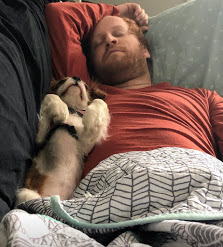
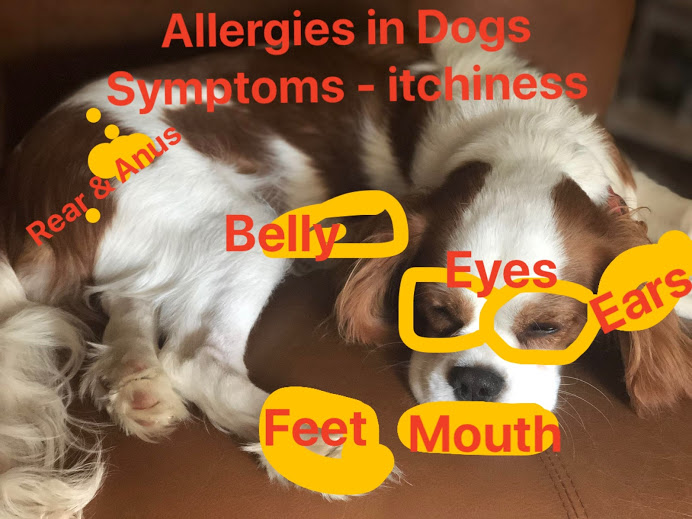
    Our model Breve (1/17/20) shows us where the typical allergy issues show up.

    Thump, thump, thump…no matter where the dog is, when they are itchy, it seems EVERYONE suffers with him. Samson, our lab seemed to suffer especially in the late spring, early summer. His ears would be red and inflamed, and his hind-iney was a big “need to scratch” area as well. We worked on his food, baths and a lot of natural products…nothing seemed to work…until the Vet gave a prednisone shot for his “Otitis”. A few years later, the Vet gave me a large dose of Prednisone tablets. At the earliest sign of that summer allergy, I would give 1/2 tablet and try and stay on top of his suffering.
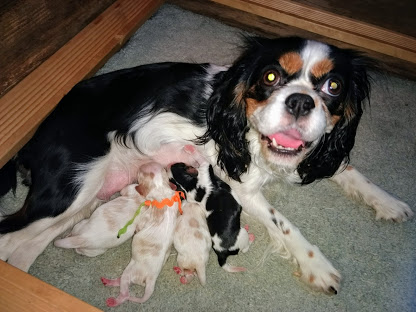
    Mercy’s hormonal itching typically dissipates after whelp.

    Mercy didn’t have issues except right before delivering puppies. Hormones also play a big part in the challenges of itching…and for her, there’s not a whole lot I am able to do for her…except time her contractions.

    Lovely Lovie’s post-bath and grooming ears.

    Pets often suffer with allergic otitis and dermatitis for a plethora of reasons. Your fur-baby may lose weight from the constant motion of scratching and rubbing. Sometimes the problem can be easy and cured with a few little things you have around the home, or, in so many cases, it will take years and a lot of expense to determine what is bugging little Fido!! I hope this article will help narrow the possibilities and expand your understanding of the mystery behind allergies. Allergy is defined as “damaging immune response by the body to a substance, especially pollen, fur, a particular food, or dust, to which it has become hypersensitive.” If you haven’t done so before now, be sure to read my blogs on ear care, which could also help with determining issues in those floppy ears: https://lifewithcavalierkingcharlesspaniels.com/spaniel-ear-care-part-1/

    There are three main culprits for allergies: environment, food and parasites, so similar to us humans!

    This may seem a little over the top, but in order to rule any of the possibilities of allergens out, you will need to keep track of the whens and whats in your fur babies life. I keep a Google Calendar on my Smartphone and have each of my pet’s in a color code to make it easy at a quick glance to see any important event, as well as be able to talk with your Pet Professional about the challenges.

    ENVIRONMENT: Does your dog ever “chew his paw pads”? Is your dog constantly battling with red skin and itchy? That’s one of the big red flags of environmental toxicity. Although pets can also experience hair loss, skin infections, sneezing, watery eyes, vomiting and soft stools. Here is a list of things he could be reacting to: floor cleaner (toxins), aerosol sprays, laundry soaps and dryer sheets, pesticide/herbicides, flea bites, molds, lice or mange. Definitely take a look at each thing one at a time and remove from his home completely (forever).
    DIY Air Fresheners

    TIP: 1/4 Cup Vinegar for a quart spray bottle (filled with water and a few drops of citrus essential oil) makes a fantastic cleaner as well as a foot soak, should your dog be needing a relief from his paw itchiness. I like to take a teaspoon of organic coconut oil and massage into his skin, its anti-fungal, anti-viral and anti-bacterial – it can bring comfort and heal. Also, if you enjoy the plug-in air refresheners, you might want to do something like I did: get the Plug-In type, dump out the liquid that is in them and add your own essential oil (1-2 drops is all that is needed) https://amzn.to/2QgovK3 Other things that could help is: detoxing, acupuncture and massage in order to boost your furry companions body.

    FOOD: Has this itchiness come on suddenly? A good thing to consider is a change in his food. You may be feeding the same thing, but Manufacturers are constantly changing recipes without your knowledge. Be sure to learn how to read the labels and if you can’t pronounce it…toss it! A limited ingredient pet food is a good way to begin looking at food as the culprit. As many of you know, I fish, garden and hunt for the majority of my pet’s food and when I’m looking at a new itchy dog, often it’s due to my negligence in this area. Other than being very itchy, food-related allergies can leave a dogs fur quite brittle in addition to sparse. If there are skin issues, I am sure to use a comforting oatmeal-type bath and shampoo such as this:https://amzn.to/3ldeqvk Here’s another plug for organic coconut oil is to feed a teaspoon each day. The MCT (Medium Chain Triglycerides) job is to boost the immune system. I personally use, as well as feed my dogs this MCT Oil: https://amzn.to/3hkYTaM

    Recently my year old Faithie was biting at her legs and paws. When I took the time to think through her diet, I realized that I had not skinned several pieces of the chicken that I used in her raw, ground food. It is my (not supported by proof) belief that it is not the chicken that many of our dogs are allergic to, but what the chickens are fed and then the bi-products of the chicken that is put into the food (such as my example above as well as feathers which is often found in kibble). Dr. Judy Morgan reminds folks that healing the gut is critical and necessary if we are ever to get on top of pet’s allergy issues: https://drjudymorgan.com/blogs/blog/you-cant-solve-allergies-if-you-dont-fix-the-diet?_pos=1&_sid=7addc8f07&_ss=r

    Tip: Hemo-Pet has a fantastic Food sensitivities and intolerances test that is both thorough and economic. For a great article and video click here: https://healthypets.mercola.com/sites/healthypets/archive/2011/07/26/a-great-tool-for-dogs-with-rumbling-tummy-gas-diarrhea-or-vomiting.aspx or, just see the page: https://hemopet.org/dog-and-cat-nutriscan/?utm_source=google&utm_medium=cpc&utm_content=nutriscan&utm_campaign=adword&gclid=Cj0KCQjwhIP6BRCMARIsALu9LfnLKeck8Ntwi5v24O5lSrsqT_4okiQPDV4WSPJ1lvdEWB6sCoTvov0aAh0dEALw_wcB

    Tip: No Bake Itchy-Be-Gone Treat Bites

    Mix Together and Roll (in powdered peanut butter – optional) into 1 Tablespoon cookies, refrigerate and use in a week or freeze: 1/3 cup MCT (or coconut oil), 2 Tbsp Pumpkin or Unsweetened Applesauce, 2 1/2-2 3/4 cup ground oat, spelt or quinoa flour, 1/4 cup Natural Peanut Butter

    Parasites: I cover most all that I possibly could in the blog I wrote: https://lifewithcavalierkingcharlesspaniels.com/fleas-ticks-and-other-parasites-its-getting-itchy-in-here/ If you have any further questions, don’t hesitate to ask!

  • Titer Testing: A Solution to the Vaccine Controversy?

    Mercy is my nearly 5 year old Tri who can be seen with me on most occasions. Sweet as can be, I want to ensure a LONG, happy life for her.

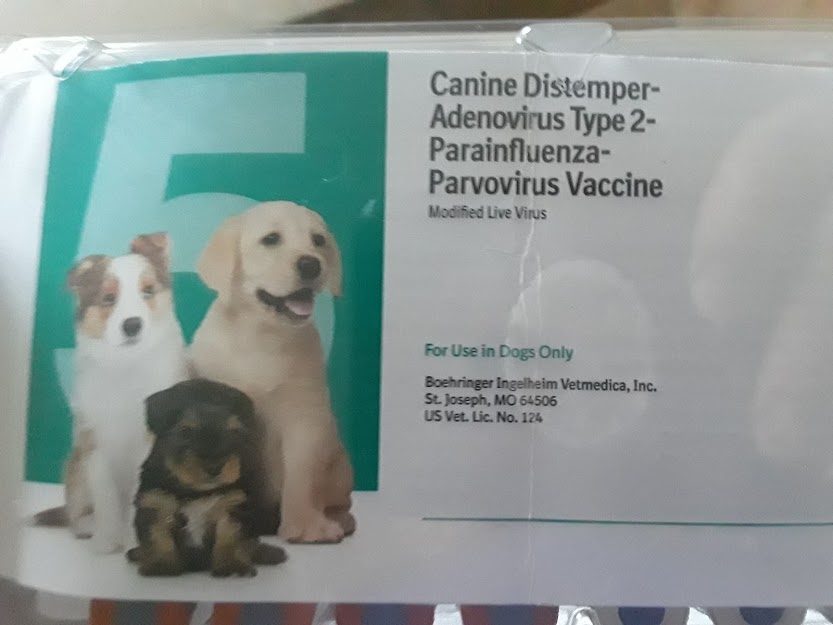
    This is the 2nd time the topic of Vaccines (and their Injuries) are being written about – on the Anniversary of my blog, because the topic is SO IMPORTANT! Mercy (above) hasn’t had annual shots since she had her One Year Old Boosters! Having learned about Titer Testing vs. Vaccinating, I decided to put my theory to work. At almost five years old (August 17) her Distemper, Parvo and Rabies proved excellent levels of immunity (see results below). I was also glad to see that, even though I have never used prevention against it (we are not on the map to need), the $15 heart worm test showed negative. Woohoo! No Immunizations will be needed for at least another year. You maybe have never heard that word…titer? I’m not surprised. Most of us haven’t. Marketing doesn’t get paid if it doesn’t sell you something.

    “The antibody titer is a test that detects the presence and measures the amount of antibodies within a person’s blood. The amount and diversity of antibodies correlates to the strength of the body’s immune response.”

    https://www.dogsnaturallymagazine.com/five-vaccine-ingredients-that-can-harm-your-dog/

    In the years that I have been in love with the breed, I am disheartened by the numerous stories and statistics of dogs who suffer and tragically acquire cancers (depending on your source, it is said One of every three or four dogs will develop). When researching the ingredients that are IN vaccines, it’s no wonder! https://mysatisfieddog.com/vaccine-ingredients/

    As a lover of dogs, aficionado specifically of the Cavalier King Charles Spaniel and Puppy Breeder, I know it is of utmost importance to study each topic fully and then communicate to my friends and family urgent issues that may be concerning them in this regard. Therefore, my stand on Vaccines is: have them spaced out, never more than one at a time (to identify potential adverse reactions) and one booster around 14 months of age. After that, annual titer testing on the specific antibody, which could last up to SEVEN YEARS! I will spell out the details of how you would do this at the bottom of this article. 

    Just as the dozen or so Veterinarians who came together for the very imformative Documentaries “Pet Fooled” (Prime and Netflix has both carried this) and “The Truth About Pet Cancer” https://thetruthaboutpetcancer.com/ have said, vaccinating year after year makes as much sense as vaccinating ADULTS with the same infant shots each year. Speaking out in both Documentaries, one of my heroines, Dr. Karen Shaw Becker said, “I’m perpetually annoyed by the conventional veterinary community’s casual, often purposefully uninformed view of re-vaccination and its potential to trigger adverse reactions in pets. The vast majority of veterinarians continue to promote automatic re-vaccinations rather than titer testing to see if animals even need that second or third or tenth re-vaccination against the same disease.” (2)

    Task force member Dr Richard Ford, Professor of Medicine, North Carolina State University, said the decision to recommend a three year core vaccine revaccination schedule was a compromise. “It’s completely arbitrary…,” he said. “I will say there is no science behind the three-year recommendation…Profits are what vaccine critics believe is at the root of the profession’s resistance to update its protocols. Without the lure of vaccines, clients are less inclined to make yearly veterinary visits. Vaccines add up to 14 percent of the average practice’s income, AAHA reports, and veterinarians stand to lose big. I suspect some are ignoring my work,” says Schultz, who claims some distemper vaccines last as long as 15 years. “Tying vaccinations into the annual visit became prominent in the 1980s and a way of practicing in the 1990s. Now veterinarians don’t want to give it up.” (3) I say, “follow the money trail”…all the way to the grave.

    Last October and November were quite scary for a Dog family I know; she adopted ruby boy Duke, summer of 2018 from me. Shirley LaRoque called me in a panic and I tried to help her suggesting as I do with each of my puppy owners post Rabies shot, to administer the homeopaths of Belladonna and Lyssin (or Apis for facial swelling) and can be administered every 6 hours until the reaction subsides. Other homeopaths I have for my pets are: thuja, silicea, and melissa to name a few.

    Sir Duke’s Story

    I asked Shirley to recall this awful season of Post-Vaccine Adverse Reaction for you and this is what she said, “Jina taught me, during the time that my Duke was being reared in her Puppy Kennel, how important it was to space out the vaccines as well as doses that would be needed once we had our puppies. One of the things I remember her saying was “never allow the puppies to have a FULL DOSE of the annual shots and not to allow them to be shot near their necks or to leave our sight”, so for the first year, the three boosters and rabies, we had NO problems. Duke was my perfect angel and has been my Support Dog since day one. Last Fall we experienced a Life Threatening Toxic Overload that had us on pins and needles for almost two months! I hope I can help someone else with our story. We went to our normal Vet here near Phoenix, AZ, the one we have always seen, in fact, Duke had his annual 5-in-1 shot one month earlier, he was now due for his Rabies Booster. He seemed healthy and ready for this vaccine, except for two minor seizures that had come on and off suddenly since his annual booster. Unfortunately, the day of his shot, I guess I just trusted that the staff knew us and remembered what we wanted. First of all, they took him out of the room, saying they didn’t want to upset me if he cried (something I never will allow again) and when they brought him back, I could tell SOMETHING WAS OFF. I was frustrated, but didn’t say anything…not until a few hours later when Duke was SO LETHARGIC; he hadn’t eaten or drank anything all day! I began to call the Vet almost immediately. They said I should give a benadryl and to watch him through the night…the longest night of my life! Now, almost 24 hours later, I was watching my little guy’s life slip away. The Vet said that these were “normal” under the conditions (Annual Shots? Rabies? Really?) and to keep trying to offer food and water. I maintained a 24/7 watch over my boy, offering his beloved ice chips, a variety of chicken and food…anything? He wasn’t eating or drinking and my Vet did not seem concerned…meanwhile I was a nervous wreck!

    After the 3rd day, I brought Duke to an Emergency Walk-In Specialist who put him on I.V. therapy including electrolytes and asked me to come back the next day. Because Duke was so weak, we HAD to go in each day for 3 weeks straight! After about 10 days of carrying him and dripping water and bits of food, I was able to coax my boy to walk outside rather than be carried. Three weeks later, he began to walk around. Almost six weeks later, he would initiate food and water. It took my boy THREE MONTHS until he was back to “normal” (jumping up onto my lap, chasing his balls, etc). This Normal was AFTER I had been giving my boy Organic Bone Broths, Pro-biotics, Pre-biotics and other supplements to pull those toxins out of his body and help his body heal. Since that time, I have been talking to others and have found that my story is not unique, unfortunately. Two of my friends who also have dogs within the TOY Breed Category (Lhasa Apso and Pomeranian) have also had Adverse Reactions to their annual shots and almost lost their dogs. Each of us have pretty much decided to keep our dogs healthy and not give them annual shots. We are working with Holistic Veterinarians who encourage Titer Testing (the same that Jina does) rather than annual shots. Since this, sadly, I have seen stories like mine all over the web. My boy is the love of my life and I couldn’t bear a day without him. I hope our story helps you make good decisions for your fur baby.”

    Is There Help?

    Now what? What can you do to prevent adverse reactions or cancers that are caused by over toxification within your pets system? I believe in a holistic approach to all healthcare. Prevention is worth a pound of cure, right? So, keeping our fur babies’ gut and environment healthy and keeping them active helps a LOT! If it’s time to vaccinate, then look at microdosing your boosters and be sure to stay away from the neck area. Dr. Judy Morgan says “if the vaccine is mandatory (Rabies for instance), I do recommend pre-treating with an antihistamine and having the vaccine given at a time when you are available to stay at your veterinarian’s office for at least one hour after vaccination to watch for allergic reaction. If vaccine exemptions are allowed, that would be my preferred way to avoid giving a vaccine that may cause anaphylaxis (severe allergic reaction leading to shock).

    Vaccinations should never be given to a pet that is ill or undergoing an anesthetic procedure. Multiple vaccinations should not be given at the same time. Vaccine injections should be given low on the hind legs, never over the shoulder or loin area. If a tumor develops secondarily to the vaccine, leg amputation might save the pet’s life, whereas a tumor over the shoulder or loin area would be very difficult to remove.”

    When inquiring with my Veterinarian’s Office for Titer Immunity Testing, unfortunately the cost is so high that it typically prohibits people from seeking them out (apx. $100 per strain that you are testing). The good news is that there are several lower cost places that will test. I found the best price point through https://hemopet.org/titer-testing/

    During Mercy’s annual health check, a simple blood draw was spun and given back to me. I already paid and printed out the instructions and brought it to a UPS drop. It was really THAT easy. Most of the results were given to me within a few weeks, though the rabies took about a month to get back. I received an e-mail to let me know the results, and now I’ll share them with you!

    It is my hope that in writing this blog post that I have informed you of another CHOICE in order to maintain a healthy and happy fur baby for LIFE…full life. If I have, please drop a comment and share this article with friends. Until next month..

    FOOTNOTES:

    1. https://www.puppyup.org/how-to-minimize-adverse-vaccine-reactions-in-your-pet/
    2. https://www.dogsnaturallymagazine.com/five-vaccine-ingredients-that-can-harm-your-dog/
    3. https://drjudymorgan.com/blogs/blog/is-your-pet-over-vaccinated
  • “Leave it”

    Rocks, stick, toys, slippers and more sometimes end up in our fur-family members mouth; so when it is necessary to see a Professional for help? Is there anything we can do when we think it’s an Emergency Situation?

    “Breve’ is just not acting herself since our mornings walk and we aren’t sure what to do for her” was the call I received about a month ago from Tyler Whitlock and his worried fiance Mimi.

    Tyler and his sidekick, Breve’ (Kalama Cavaliers Precious Hopie born 1/17/20)

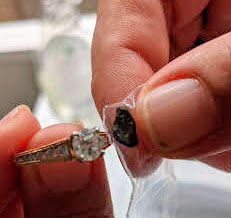
    I asked about a dozen questions and found out that four month old Breve had been her normal puppy self until right after the walk, so I immediately thought of toxins. I encouraged two capsules of charcoal and take her temperature (canines of all ages and sizes range from 101-103ºF) and to monitor her for any vomiting or defecating.They called and set an appointment with the Vet for 24 hours later, but felt she was declining so rapidly that they decided to bring her into the Emergency Vet immediately. When they did so, the x-ray showed “some large object, resembling bone” in her bowels. The Vet office felt it best to have Breve remain overnight, being monitored and keeping her on IV fluids. Worried pet parents had to wait through the night and into the next day, hoping for the call that things were okay. The Veterinarian was hopeful Breve would pass the “bone”, but wanted to ensure she didn’t have any problems doing so. Sure enough, around 5:00 pm, apx. 30 hours after their walk, Breve had a stool that showed the nemesis – a rock. Apparently Breve has been habitually mouthing “everything in sight”, including rocks of all sizes. She is leash walked, and her parents keep attempting to have Breve spit those treasures out, but, apparently this “huge bone-type substance” was suuuuper uncomfortable for baby girl.

    I had Mimi put the rock next to her shiny engagement ring for me to compare the difference. As you can see…both of these “rocks” were quite an expen$e. Sooo, what do YOU do when you are faced with a similar problem?

    A quick search of ingesting non-food-related items will shine the spotlight on Pica. Websters defines Pica as “Craving and chewing substances that have no nutritional value, such as ice, clay, soil, or paper.” A fairly normal condition, particularly with teething puppies who are learning his/her environment, they also crave a variety of foods and minerals, but could point, especially in older dogs, to underlying conditions. Always speak to your Vet about concerns.

    When they are young, puppies can learn a new habit a day. We, their Guardians, get to help them learn GOOD habits and training toward success. My Dog Trainer, Marjorie Geiger of “Banner K-9 Training” (155 Elm, Kalama) reminded me of my need to have separate commands of my “Down” and “Off” – which sometimes has been used interchangeably. Similarly, “Leave it” and “Drop it” are essential to training for our dogs, as Kaelin Munkelwitz (of “All Things Pets”) points out in her easy to implement training video: https://www.youtube.com/watch?v=4cQNc2-nn_8 This video has helped me particularly with my rabbit and deer poop eating (and rolling in) dogs. I’m not at 100%, but working toward that goal.

    Healthy, long lived, dogs come from families that make their well being their priority. Food, nutrition, rest and training need to be a daily habit for your fur baby. You’ve committed a lifetime to this dependent love bug, now you need to hone the time to be building on the training of the past. You CAN teach old dogs new tricks…with a ton of praise and consistency.

    Kalama Cavalier’s Lady Gracie loves her Chewies

    Gracie never outgrew her Puppy gnawing, mouthing, chewing. She ALWAYS had something in her mouth, or else, she would be digging (couch, bed or dirt) to find or bury her treasures. So, when her owner, Ashley Butler called me to let me know that Gracie “was fine during my lunch break, but when I walked in the door around 5 pm it looked like someone had been murdered”, we both knew SOMETHING AWFUL was happening. Blood work and barium x-ray showed that she had a bowel blockage with a sever in her bowel. They had to go in to do immediate surgery and an overnight stay. Ashley and her family believe that Gracie most likely, swallowed a few too many bark chips! Ugh, really?! I read in “Dog’s Naturally” that if not caught, a dog could lose so much blood during a bowel obstruction that the dog could quickly die. https://www.dogsnaturallymagazine.com/bowel-obstruction-in-dogs/

    Aside from a high temperature, it’s important that anytime something is “off” with our dogs, we take note. I might scribble something on a wall calendar or on my phone ie: Faithie didn’t eat breakfast and seems lethargic this morning. In conjunction with bleeding, bloating, vomiting, severe diarrhea, I will most likely get in to see the Vet asap.

    If the symptoms don’t seem to slow my doggie down, I might note it and then see if there is something natural I can do to assist my pooch. Here are a few of my go-to’s in my Pet First Aid Kit (I will be doing an entire blog about 1st Aid in the near future):

    • Gurgling Tummy accompanied by grass/herb eating, I will give 1 capsule of Slippery Elm Bark (I usually roll in a bit of cream cheese or deli meat: https://amzn.to/31aasMH
    • Diarrhea or constipation? I will add a teaspoon of Canned Pumpkin (no seasonings) in the food until the bowels have returned to normal.
    • If I suspect a toxic substance has been ingested, I don’t hesitate to give 1-2 capsules of Activated Charcoal, until pup can be seen by the Doctor or the symptoms have dissipated (see story below about Lovie’s rat poison “treat”): https://amzn.to/2Vb3y5U
    • Plain Pedialite – if there has been a bout of diarrhea, I might give some to re-hydrate. I also keep some organic bone broth on hand (this is a convenient, easy way to store): https://amzn.to/3duYsI0
    • Hydrogen Peroxide: have a small, unopened container on hand that has not expired at all times, should you need to induce vomiting.

    Moving furniture in our Guest Room proved to be a lot bigger challenge than I had pictured. Not only was the Queen Bed not fitting in the area I wanted, but the heavy Queen Anne 12-drawer dresser was a 3-man job. When we were finished in that room and ready for a cold drink, I was surprised to hear my normally quiet and calm husband shouting “Help me! She got it”! Sweet and docile, 2 year old Lovie was in and out of the room while we were reassembling our puzzle-of-furniture maze. There was a TRAIL of green particles all the way down the hall and into the great room. It happened so fast, I was unsure of what had just taken place.

    Who me? Kalama Cavalier’s Madam Lovie…after our scare!

    At the end of the trail was Lovie chewing on the hard green mouse/rat bait that had apparently been under one of the pieces of furniture…highly toxic to anything that ingests it. It was late, we live over an hour from the Emergency Vet…so, we dove for the charcoal and hydrogen peroxide. In that first hour I gave her 5 activated charcoals. She never did vomit because we found out later that the bottle hydrogen peroxide had expired. Two hours and a few meals later (to dilute and push through) she had a GREEN AND BLACK bowel movement! We stayed up all night monitoring and walking our baby girl and by 8:00 the next morning we were at the Vet’s Office. They took a quick look and said we “did everything they would have done” except that they gave us Vitamin K-12 to assist with blood coagulation, should she have a bit of the bait still in her body. Needless to say, we have tossed all the baits and toxins out and have opted for a more natural approach (“here, kitty, kitty”).

    Another UNBELIEVABLE story of swallowing is about Finn. When Finn(agin) was about 6 months old, Kari McPherson’s boy was gnawing on his nightly bully stick at her feet. These were the sticks the Breeder (me) recommends for teething as well as a quieting/calming for puppies. Kari was shocked when, 5 minutes later, her pup acted like he lost his special stick. The family frantically began to tear the area up, hoping he didn’t swallow it. Just to be certain, they took that scary drive to the Veterinarians office for the x-ray that showed he HAD indeed swallowed “something” and it was already passing down into his intestines.

    Bella’s boy Finn (1/19 litter)

    Kari shares: “We stayed at the vet the entire time until the bully stick passed into the intestines. It was lodged down his throat and into the upper part of his stomach when we arrived. It took about 4 hours for that process to happen and for the x-ray progression to show it was going to pass. Most heartbreaking was his horrible painful cries as it was poking him so badly from the inside! The bully stick was still 3/4 of its size when he swallowed it whole. I will NEVER feed a bully stick again!” I understand completely. It’s those scares that change our world around.

    The BOTTOM line is know your dog…yes, inside and out. You are its advocate now…be that Super Sleuth in all departments. Keep an eye on any changes…so you can make a difference in his life (sooner rather than later)!

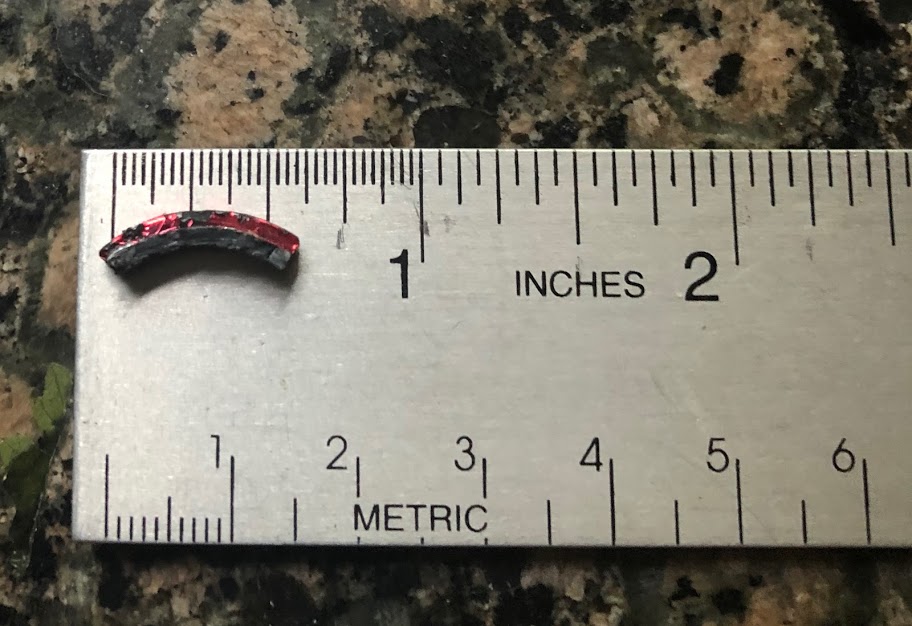
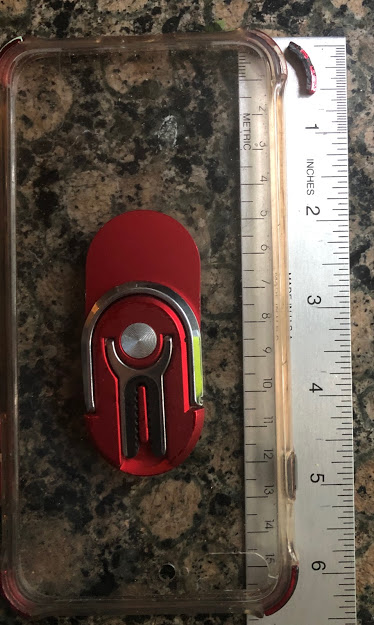
    It’s only because I LOOKED that I saw this…what I now know is a corner piece to my cell phone cover, in Libby’s poop a few weeks ago! She wasn’t lethargic and I had been walking her on a leash the night before, so I knew that she was not constipated. Below is the slide show of “Kalama Cavalier’s Lady Liberty” aka: Libby and her “treasure” as well as a few pics the same week including with her 2 moth older sister Breve’:

    I don’t normally see bright red shiny things in the poop, so, being the advocate that I am, I used a stick and a leaf and brought it to the sink to scrub up (what you see is a clean metal piece). Wow! That was a CLOSE call!! Little 3 month old puppies are naturally curious, and this was hard, shiny and very pokey!

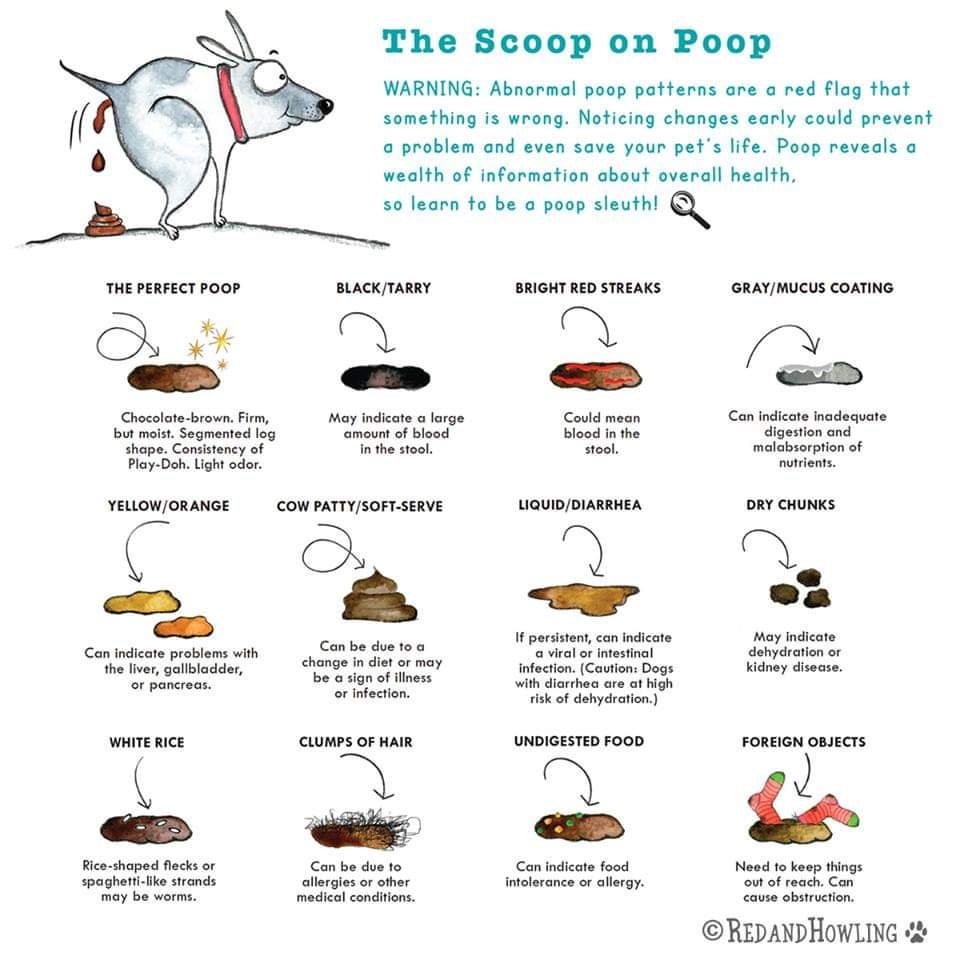
    Just as this article points out, keeping our dogs neurologically stimulated helps them in the long run: https://www.k9ofmine.com/stop-dog-from-eating-rocks/ The bottom line here is: KNOW YOUR DOG’S “NORMAL”. Study the breed and do “right by the dog” as my friend Lynda S. Cantwell is heard saying. This chart is a fantastic help for those of us who want to know “what is going on with my dogs poop?”

    What about you? Have you ever had your furry companion swallow something that scared both of you? How did you handle this challenge and or problem? Help others by droping a Comment below or sharing this article.

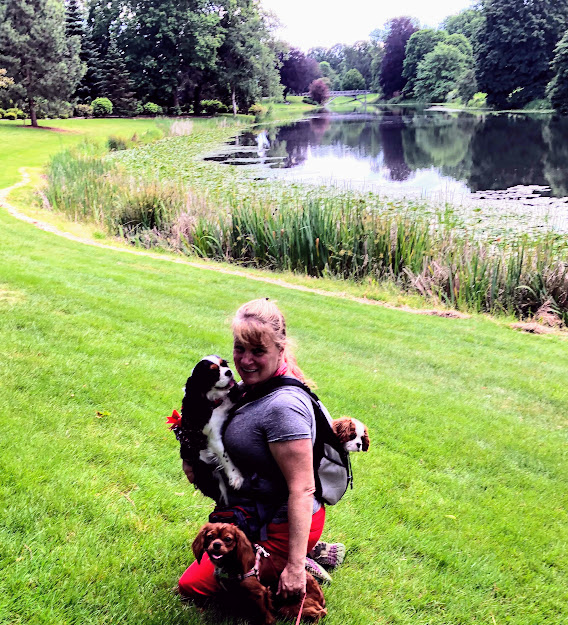
    A few of my girls and I on a 3 mile walk around Lake Sacajawea in Longview last week. The baby got the pack while the older girls got to walk and say “hello” to everyone.
  • Your Puppy’s First Days with You

    My daughter, Jewel, and 8 week old “Lady Liberty” aka: Libby on her “Gotcha Day” 5/8/20
    Our happy parents, Sir Willy and Madam Lovie show off their sweet 5 week old pups.

    If I had 100 puppies during the Covid-19 Pandemic, it wouldn’t have been enough for all the serious inquiries that have reached out. The shelters are empty (yay!) and every dog has found their human. Our hearts are full(er) with these furry companions to walk these days of “New Normal” with. I want to share a few tips that will make your new furry companions first days with you as stress free as possible. We have had many puppies leave our home, but it’s only been recently that we have had the wonderful addition of sweet 8 week old Libby. In the next year, I have reserved two other puppies (black & tan female and tri male) so I’ll need refreshing at that time as well. So, this blog post is for all of us who will ever experience that New Puppy Experience. While this experience is fresh in my mind, I thought there might be others who may appreciate the tips that have helped us, and many others along the way. Much of the following info. can be found in the 5th chapter of the book I was featured in, Amazon’s Cavalier Best Selling Book: https://amzn.to/2ZP2yHL

    Hopefully you have found a pup or dog from a reputable breeder. If you have any doubts, please read my 2-part blog on Puppy Mills: https://lifewithcavalierkingcharlesspaniels.com/puppy-mill-or-reputable-breeder-how-can-we-really-tell/ Having a well adjusted, amiable dog, our puppies need to begin their first steps with a strong and confident human who has made a plan for their success. I like to say “that cute three month old who whines and begs for your attention isn’t so cute when he’s three YEARS old.” This blog post will give you a step-by-step plan to help both of you soar into it’s old age with grace and glory.

    Our puppy Packs are loaded and ready for their new families.

    When picking up your puppy, be sure to allow TIME (apx. one hour) to transition from their 1st human family to yours. You should receive (and go through) a few items during that pick-up: a blanket that smells of the kennel he came from, a bit of the food your pup has been eating, and paperwork (including the Vet notes and Purebred Registration, if applicable). It’s good to pick-up earlier in the day, so that the transition to you and your home and family can take place before the evening comes. Bring a crate, put the puppy in with the blanket and sure enough in a few minutes of travel, he will be resting quietly.

    Sweet 8 week old pup sleeps more than 18 hours a day.

    Humans tend to breath out a big SIGH when we need to destress, canines yawn. As well, they often will look away. It would help your pup if you do the same (yawn and look away). Being aware of a dogs body language will help your fur-baby begin that trust and bond that you will tap into for many days to come. I like to purchase the Adaptil “calming collar” to have for that first car ride and adjustment into the new home environment. This one lasts 30 days and is a nice, drug free way to bond and connect. It has a small release of pheromones that sends messages of comfort to your pup. Here is a link for the Puppy Collar: https://amzn.to/36IOl0r There are also diffusers that you can have around your Puppy Area as well (though most Cavaliers adjust quite quickly).

    Remember, dogs have an incredible sense of smell, even up to a mile away. Remembering this, you want to clean your house, but please, do not use harsh toxic chemicals. A spray bottle of 1 part white vinegar, 3 parts water will do the trick for most household cleaning. I use a air purifier after cleaning at least a day or two before a new dog/puppy arrives (and then turn off a day before bringing him in).

    Walk your new furry friend around the perimeter of your yard as soon as you arrive, and use the word that you have chosen in the specific area you want him to do his business – I use “go potty”. This is to be repeated apx. every 2-4 hours around the clock for the next two weeks. (Side note: I like to use a bell each time I walk through the door area to get the puppy ready to train to “ring when I need to go out” and will help YOU for all your live long days. Here is a link to bells and clickers to begin early training right away: https://amzn.to/36IOl0r

    Those first 10-14 days are critical in the development of bonding, attaching and training. If you MUST share that puppy love with others outside of your home and family, Video Chats are the best way. Keep your puppy’s world SMALL. The puppy’s immune system is just now developing, he has all that amazing nourishment from his Dog-Mom, in addition to those first puppy shots (8-10 weeks), so there’s no need for fear, just caution. If you aren’t sure if the grass has had Weed-n-Feed or flowers sprayed with pesticide, keep a distance! I hope you had time to prepare an outdoor and indoor area for your fur-baby and you are ready to see how he adapts. I like the indoor/outdoor fences and use them all the time until completely potty trained. If you need a supply list of good recommendations, I have many Puppy recommended items on my other page here: https://lifewithcavalierkingcharlesspaniels.com/new-puppy-set-up/

    That first night the pup is typically worn out from all the changes and excitement, so a good night sleep is almost certain to be had by all. Be forewarned: there are a few times each day that your new pup will have the “zoomies”, or , as the Vet community calls it “FRAPing” (which stands for Frenetic Random Activity Period). It’s literally the exuberant bursts of energy he will display for 5-10 minutes of running around and playing that takes over our puppies. I find that this will happen just before they are ready for a good long nap.

    “Bear” is ready for his furever family.
    Tucker and Bentley snuggling with their bully stick

    A few “tricks up my sleeve” for that nighttime sleep is to put the travel crate (with his blanket) next to your bed. When he does awake, you will hear and take him out promptly. Don’t expect a full night’s sleep for several months – until his bladder is strong enough to be held. A rule of thumb is apx. 1 hour of sleep for every two weeks of life (or thereabouts). Again, ring your bell, say your que word and go to the same are of your yard each time.This is most likely the first time your puppy has been away from his litter-mates and Mama.

    Your pup will appreciate being offered a little “midnight snack” and drink and maybe even a ball toss. Sometimes the nighttime oil carries on for an hour or two before he is ready to cuddle and be put back in his bed. I like adding a bully stick or hard chew toy in the crate when I put the puppy back, sometimes the chewing helps to rest and relax. Some people like to add a rice bag (a drop of lavender) and a wind-up clock nearby – to immolate heartbeats. There are stuffed animals for this type of thing as well: https://amzn.to/2XEngrb A soft music can sometimes help block out the new and unusual sounds that puppy isn’t used to – there are plenty of playlists on YouTube like this one: https://www.youtube.com/watch?v=oIMiZA1PGKE&t=2295s – especially when you leave pup alone at home.

    Now that you’ve gotten through an entire day with your puppy, hopefully you both are feeling a bit more comfortable. You’ve gone through the paperwork, gotten a few meals down and are getting into your routine. Definitely take the time to look at his bowel movements. It’s quite normal during the change in his environment, to have soft stools. Here is a chart and explanation of “normal” poo: https://www.bigdogpetfoods.com/guides/whats-your-dogs-poo-telling-you

    If your pup isn’t eating, vomiting or has true diarrhea, these are indicators that something more could be going on (parasites or bacteria), get in to your Veterinarian ASAP – and don’t forget to bring that poo sample. If it is just softer than you’d like to see, add a teaspoon of pure (no added seasonings) pumpkin. **Watch for an upcoming blog on your Dog’s 1st Aid Kit.

    Libby got a visit from our Great Neice @missabigailrose – everyone loves a puppy!

    From the 3rd day of life, I begin a “Early Neurological Stimulation” which helps the puppies ability to adapt and adjust to his environment and potty training. While in my home, I commit to introducing a new “thing” each day. It might be a new sound, texture, taste or person. When you bring your pup home, it would do you well, to continue this learning process. Use this checklist (or find another/make your own) “100 Things in 100 Days”: https://www.preventivevet.com/puppy-socialization-checklist-100-things-in-100-days

    A few things you will need to decide pretty quickly to help this amazing transition go as smoothly as possible are:

    1. Schedule your Veterinary Appointments for the next three months of Vaccine Boosters (remember to bring in a fecal each time to check for parasites) and nail trims.
    2. Plan on a week (minimum) to spend 24/7 with the puppy and help him adjust, crate & potty train.
    3. Puppy Obedience Train each day (1 minute per week of life) and schedule a Puppy Training Class. and
    4. Who will be on “Puppy Duty”? Write it down so that there’s no question.

    I hope this blog has helped you get geared up for your new furry love! If I didn’t address something you think is a concern, would you consider writing your question below?

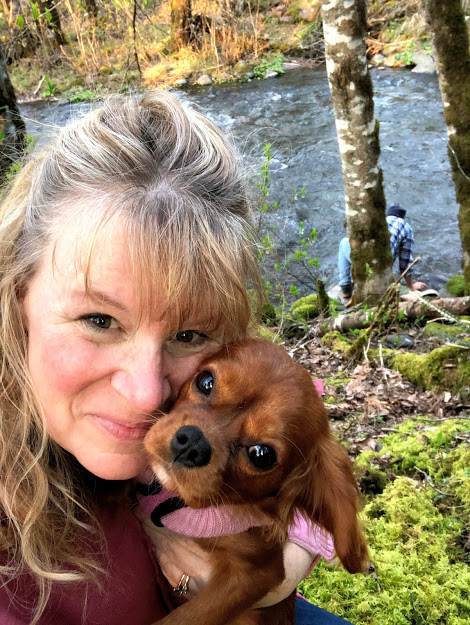
    Me and my sweet ruby pup, Faithie.
  • Just Shoot me! A limited approach to Vaccine injury and exposure

    In the late ’80’s, the Veterinarian I worked under, Dr. Halverson, educated his clients and staff on going against the Pharmaceutical and F.D.A. recommendations toward vaccine protocol. The “Protect the Pets” website, my go-to in learning about advocating for limited and smaller dosing of vaccines, has helped me reason through how to communicate with a variety of people. “Protect the Pets is a grass roots movement lead by Dr. Robb to educate pet owners about the realities of over-vaccination and to inspire veterinary professionals to value the health of pets over the drive for profits.” Speaking to the Connecticut Public Health Hearing, Feb., 2017, Dr. Robb states at the end of his passionate speech, “I have a Hippocratic oath that is greater than any law that is passed in the state of Connecticut that would make me kill my patient. I. Won’t. Do it!” watch here:

    The phone call I received that day several years ago proved to me that I needed to communicate a LOT stronger about how I have witnessed the painful over-taxation of puppies’ little systems. This little boy had been crying “over 12 hours, since his vaccine”. In probing a bit more I found out that the shot had been given into his neck…and now his is most likely injured for life. I hope to help those in his wake!

    George is healthy and ready for his first dose of Core Vaccinations.

    This blog specifically is addressing the CORE Vaccines (distemper, parvovirus, hepatitis) and Rabies. I will address other, non-core viruses in a future blog post (like brucculosis, leptospirosus, canine parainfluenza virus (CPiV), canine influenza virus (H3N8), canine influenza virus (H3N2), distemper-measles combination vaccine, Bordetella bronchiseptica, and Borrelia burgdorferi, lymes, as well as Coronna Virus. Status quo Veterinarians have been known to inject 2-4 vaccines at ONE TIME in the same location of the pet (typically in the skin at the neck), no matter the health of the puppy/animal. I want to let you know…there is a better way! Until things change within our laws, Vet Schools/Text books and society, we HAVE to have a basic understanding of immunities and ensure the health of our animal. We can test circulating antibodies: namely, a blood titer as the true indicator of immunity! Think about it, if you have a 175 pound Great Dane Mastiff or a 4.5 pound teacup toy poodle, they will both receive the SAME amount of rabies or parvo vaccine into their bodies each year…does that seem right? I don’t believe so. Do your due diligence and advocate for these sweet, trusting animals. Meanwhile, always, always ensure that your puppy (dog) is HEALTHY when you decide to load it’s system with the vaccines.

    Willy & Mercy just completed their Boosters and will now be Titered!

    When you consider a puppy coming from a clean kennel and healthy Mother who has nursed until 6-8 weeks has developed her strong immune system, puppies already have an immune response to ward off diseases that we all fear. I, personally, have found that dosing a LIMITED amount of core vaccines a few days prior to departing my home kennel (8-10+ weeks old) in conjunction with giving a homeopath (thuja and silica later, should there be an adverse reaction). Speaking to Scattercreek Vet Hospital’s Vet, Dr. Randy Thomas recently, he said he also gives 1/2 dose injections to puppies, no matter the size, something I have been doing within my home kennel for a few years, as recommended by Dr. Jean Dodd: https://www.hemopet.org/half-dose-vaccine-small-dog-vaccine-study/

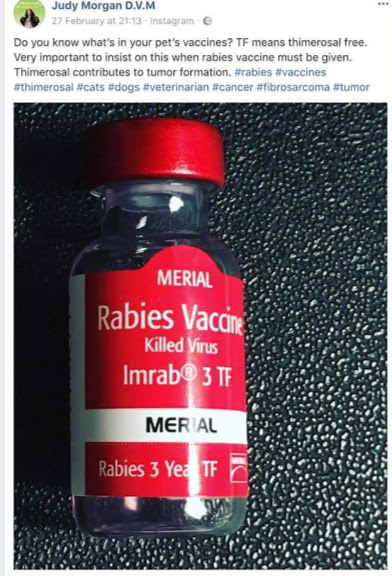
    I encourage all pet owners to keep the vaccines separate, never more than one shot, should there be a negative reaction. (For more info. on reactions: https://www.dogsnaturallymagazine.com/homeopathic-treatment-vaccine-reactions/ ) In addition, I implore that the shot is given at the hip, rubbed and iced, if needed. When the shot is given in the neck and there is an inflammation, or toxic response, it’s difficult to manage. Once the puppy shots are complete, you can wait an entire year to have another limited dose and then you can titer test for immunity – most dogs won’t ever need more vaccines. One dose of rabies is often enough. When you bring your puppy/dog to an animal clinic, I know you are putting your trust into the professionals hands, I want to encourage you to ask a LOT of questions, never let your furry companion out of your site and to insist that the vaccine protocol is followed according to YOUR desires (never on an ill or geriatric pet). If/when there is a vaccine given, do plan on watching for adverse reactions, up to 6 weeks after the shot. Report all negative reactions immediately – this is how laws get changed! If you need to have a rabies shot, always insist on thermosol free!

    After the 2nd year of booster shots, most animals are fully immunized. There is no need to inject MORE for more immunity. Check your pet by utilizing a titer test. With a simple blood draw, you can send in to Kansas State University to see how “fully vaccinated” he is! The form and instructions are here: http://www.protectthepets.com/order-a-titer.html

    Here is the Vaccination Schedule that I recommend:

    8 Weeks: DHPP Core Vaccines (distemper, adenovirus, hepatitus, parainfluenza and parvovirus) micro – or 1/2 dose

    12 Weeks: DHPP

    16 Weeks: DHPP + 1 year later (x 2) and then check for immunity through titer test.

    20 Weeks: Rabies – separate from all other shots!

    24 Weeks: If completely healthy (think gut health!), and you have done your research, then you can begin immunizing against the other various viruses and diseases if absolutely necessary, oftentimes you can check for immunity or test first (ie. Coronovirus, Lyme, Leptospirosis, Bordetella, Measles).

    Chloe just departed our kennel and entrusts her entire being into her family’s hands. Photo courtesy of her human parent: Jesse Taylor

    The information I have shared above has been communicated with each and every puppy family I have released from my home kennel. The cries I have heard in the background from those who had awful adverse reactions is numerous, but, hopefully, the guidelines I have laid out above will help some from the pain I have witnessed firsthand. I hope this bit of information helps you have the understanding that it takes to keep your pets safe and live truly happy, long lives! If you have a story or question about vaccines, feel free to add below:

  • Kalama Cavaliers Kennels – Our desire to share the cuddle-babies with the world!

    Our “baby” Jewel with Elysha’s twin boys: Bear & GusGus (2019)

    Our “Why do we breed” answer:

    Growing up with dogs of all sorts: mutts, a Collie, Springer Spaniel, Beagle, Labs; I thought it would be wonderful if we could put all the GOOD parts of these dogs together…and then I experienced them…the Cavalier King Charles Spaniel. Truly remarkable creatures, my in-laws had a few at a family camping trip and I found them to be sociable, sweet, playful, love-bugs!

    A few years later, these same in-laws needed to re-home some of their breeding dogs and knew I adored them, so she generously GAVE me a male and female. In the midst of all of the transformation, I learned about the decrepit health issues this breed is prone to, and fear set in. As you know, fear is a HUGE motivator, and, anyone who knows me will attest, I am a goal-oriented, motivated woman! A fantastic site (that may freak some of you out of even considering the breed) that I try to memorize and check back often is http://www.cavalierhealth.com

    Being the “breeding set” that they were, soon we were preparing our home to receive puppies. Again, I was just thrown into this…but I read, asked a lot of questions (it helps when some of my best friends are breeders! Thanks to Kathleen with her Mini Schnauzers, Renae with her Rat Terriers and Terese with her Havanese and Basset Hounds), I was as ready (and nervous) as I could be!

    That first litter taught me a LOT. I fell more in love with them and I planned to keep a girl to raise up for a future breeder. We were IN LOVE with Aimee.

    Elise & Aimee

    All the puppies were amazing; we were in absolute heaven and it was our joy to see them go to several local families: a sister, a friend who needed a support dog and two went to families who would be home to love on them all day…one of the criteria that I learned was that the separation anxiety of this breed is truly HIGH and they do so much better when they have their people around.

    I began health testing, yes, I am one of those who was learning AS I WAS GOING. In doing so, we found that even though Aimee tested out fine, she had a stiff gate, which truly could be genetic. We spayed her and found a good home who loves her. We found out that, albeit a rare challenge, she had “Cow Hocks” (“when the hock is set inward, resulting in a splayed look in the back legs”) and could result in hip dysplasia. Ugh. Our hearts were broken, we were now starting over. I now was accountable for all that I was learning. It was high time to go over an above…with absolute integrity!

    I immediately fixed both dogs who came to me 2 years prior as they were at the end of their breeding age, and found fur-ever homes through the Cavalier Rescue. I wanted to begin from the foundation and build a Kennel who would be known as having “the highest of health and well being standards” within the breed. This has become my goal, and I hope and pray to have lines that match my goal. Finding puppies who come from health tested lines proved to be quite a challenge.

    I went to the KNOWN sites for good lines, AKC! I started, the same way so many others find me…by e-mailing my questions and calling…literally ALL OVER THE NATION to find proven health lines. In addition I began taking the “Bred with Heart” Breeders Course and reading all of the Myra Savant-Harris books on Breeding. I was happy for a clean slate and I spent months researching, wondering if I would ever find MY DREAM DOGS!

    Having health-tested breeding dogs starts from the moment I pick them up. I begin by observing and then taking them to my Veterinarian who is also able to certify in various OFA Certifications (hips/patellas) and my Vet also hosts the Specialists to help in the other testings. Whenever I purchase a puppy, I ask the Breeder to run the horrific STD check, Brucullosis; heartworm test and a thorough fecal panel (checking for Guardia, Coxxidia, and Parvo among the sampling). I have found puppies who have had all three of these and who were NOT ready to go when the Breeders thought they were! At two years of age, OFA will accept the certifications, but I begin seeing the Specialists well before two years to begin testing. I took Willy to his first Cardiologist for a full Echo-cardiogram and found a strong heart!! (See all of Willy’s Tests here: https://www.ofa.org/advanced-search?quicksearch=Buttons%20Sir%20William

    Something I found interesting from Breeders in Europe was that they tested ANNUALLY for the heart (Cardiologist can detect the mitral valve heart disease – it is one of the top genetic issues for this breed) and eyes by a Canine Opthamologist due to ” A 2008 study of cavaliers conducted by the Canine Eye Registration Foundation showed that an average of 28% of all CKCSs evaluated had eye problems” http://www.cavalierhealth.org/eyes.htm Luckily for us, we have the Orthopedic Foundation for Animals https://www.ofa.org/ an outside registry where people can CHECK how often the Breeding dogs have been HEALTH CHECKED. In my limited exposure, I find that many breeders say they health check, but when compared, there isn’t the LONGEVITY to prove it (ie. they may have tested ONCE for the heart, but the dog didn’t come from health checked parents and they haven’t kept up on testing annually). I found a Breeder on the East Coast who had records for 30 YEARS!! She had a “sweet, beautiful blenheim boy” that she was willing to part with. I flew to South Carolina and found my boy…my dream boy, Button’s Sir William. I was in LOVE!! I picked him up and found him to be calm and adoring. The next day we toured Williamsburg, VA together.

    I researched all of the genetic diseases, called many Veterinarian Research Colleges and was learning from the foundational stages what it would take to have a long-lived, healthy Stud in my home. I found that Paw Print Genetics (as well as GenSol) had some of the best DNA HEALTH TESTING, so I ordered one to ensure Willy wasn’t at High Risk in several of the typical things that Cavaliers are prone to: Dry Eye/Curly Coat/Degenerative Mylopathy to name a few. I am happy to say, Willy is not a HIGH RISK CARRIER for any of these! Yay! You can view Willy’s DNA Test here: https://www.caninehealthcheck.com/kits/results/4620dc6c-a631-4b31-a5be-ac9ac6cfda17/share/

    This journey with my Willy was several years ago. I have walked this same journey now several more times, having prematurely retired (spaying/neutering and moving) apx. 6 dogs and puppies within five years due to their limited testing ability (the low test scores proving they may not be fit to genetically breed). I am getting understanding on how to get ahead of the heartbreaks and ask good questions. I have been where so many are…investigating with my brain, eyes and intuition.

    Why purebred? Many people, myself including, want to know if purebred is the best way to acquire a puppy. We have wondered if bringing in another breed would help the genetics. Most “experts” would say no. With every breed there is their own kind of special issues. It is best to begin with HEALTHY dogs who have HEALTHY offspring. I am committed, as my lifelong goal to breed with integrity AND heart. May this help the future dog lovers of the world. In this, I have a limit of 5 litters for each dam and will retire her into a loving home at that point. I have each of my dogs checked at minimum, once a year. I hope to always love each and every dog that I have within my home pack! As of yet, I have not ever given Breeding Rights with an adoptive puppy to anyone. I know the work that I have taken to build my kennel to the health that they are in, and I am not willing to throw it away on anyone who could, potentially, ruin this for us…and the breed.

    My Snugglers…tri coats are my favorite! Bella (pictured here) was born in our home and had three litters before being moved to another home.

    Most people find our kennel through the main AKC website . As an AKC Breeder, I agree to variety of Standards in Operating my Kennel. I personally appreciate this within the Dog Breeding World. No, as I have found (the hard way) people who have their puppies registered through AKC do NOT always adhere to the standards (of each specific Club Standards). When people find me and my puppies on http://www.akc.marketplace.com I have a list of questions that I ask before even beginning the conversation about future puppies. It is super important that folks adhere to the standards that I set for my Adoptive Homes. If folks quickly click through and do not use the “Message Breeder” button, here are some of the questions I will ask of you:

    Do you have experience with the Breed? What health Challenges are you most concerned with (hint: many of these are within this blog)? Do you have a fenced yard? Does your schedule allow you to be with your furry companion most of the time? (They HATE being left alone.) and Are you okay with learning a Wholistic Approach to Puppy Raising?

    Our family has purchased animals from, volunteered and contributed financially to the local Humane Shelter. There is a place for shelters, but there is also a place for Breeders. It has been said that if all Breeders would take the time to be sensitive to the issues of each breed, testing for longevity, then the shelters would be empty.

    I hope this helps you to understand my “why”. If this has brought any other questions to mind, feel free to post below for others! Meanwhile, you can see more about what’s happening in our kennel by following us on social media. Have you gone through a Reputable Breeder who has followed the steps listed above? Feel free to share your experience. It really does help!

  • Life’s Abundance

    Please follow these links to read more….

    https://blog.lifesabundance.com/post/2019/06/29/bulletin-fda-named-16-dog-food-brands-involved-in-official-reports-of-heart-disease1.aspx?realname=20599849

    https://blog.lifesabundance.com/post/2019/07/01/why-consumers-trust-life-s-abundance-pet-food.aspx?realname=20599849

    Our personal recommendation for feeding schedule:

    We start all of our puppies on Life’s Abundance puppy food and feed this for the first six months of life and then switch to Life’s Abundance all life stage dog food. The 6.6 lb bag of puppy food is ideal for a 3/4 cup per day feeding and will last for 30 days on this schedule. On month seven when switching to the all stages dog food, we increase to one cup per day with the 8 lb bag which will last for 30 days as well. With auto ship the price for each is only $26.56 for the puppy food and $26.30 for the all stages dog food. (+ $2.30 tax for Washington residents)

    This company also offers high quality cat food and pet safe floor cleaning supplies, pet shampoo and more – we use all of these products in our kennel.

    To sign up, just use this link: https://lifesabundance.com/UserProfile/MyAccount.aspx?realname=20707075

  • To Insure…or Not to Insure…that is the question

    Dozens of Companies, Tons of Plans…how do I wade through it all?

    Elysha waiting so nicely for her Pregnancy Ultra Sound (not covered)

    Weekly I am asked my opinion on Pet Insurance. After all, these furry companions ARE part of our family, and we want to insure each of our family members…right?

    A quick search will land you so many companies, so many plans. As an AKC Breeder, once I register a litter of puppies, my new Puppy Families are given a 30-day plan to cover the adoptive family’s exams, they hope to keep these new puppy parents obviously with them for the life of the dog.

    There are also coupons at the Veterinarian Offices for similar deals. Of course, the Insurance companies are hoping you will stay beyond the 30 days. Before you do, ask yourself these questions:

    • Can I afford to pay for my dogs health care immediately through funds I have available or saved? (A good rule of thumb is to always have saved up at least double the price of market value of your dog.)
    • Do I believe the insurance plan I am looking at will be cost effective? If I pay $50 a month to a company, will I be utilizing its services?
    • Would I be able to put the same amount I would be spending into a savings or investment account that I would be able to use at a moments notice, should a crisis or emergency take place?
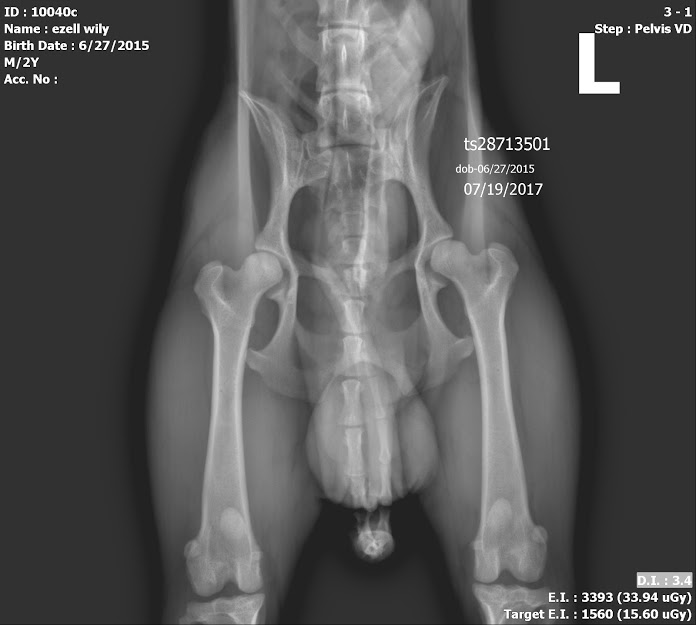
    Sir Williams Radiographs on his hips for his OFA Testing. (Not Covered)

    Is this pet your “child”? It makes a difference in the way we treat them.

    Little Finn and I await to know the diagnosis of his initial heart exam by my Vet: Dr. Cheryl McDermit at his puppy check (not covered)

    I speak to, e-mail, and blog with hundreds of new puppy families each year. Each and ever one is unique…just like their dog. Some have young families, and some will have an addition to their big furry family, some are bringing them in as a companion in those later years with their fixed income. All of the dynamics need to be explored and inventoried to find the best plan, just in case “something” happens.

    In the years I have been caring for Cavaliers (I have now had 10 Cavalier King Charles Spaniels), I have only had one true emergency which cost me $1000 out of pocket, which happened last Christmas time. We paid for this out of our Emergency Dog Fund. Due to the nature of the problem (she was wobbling and falling and her eyes weren’t focusing – we believe a slight stroke, but was never confirmed), had I not opted to bring her home, the bill could have easily been 10k because of the timing (no neurologists available until the next week – post Christmas – and they wanted to monitor her). Sure I’ve spent about 10x’s that amount in my home kennel due to the nature of breeding, but pretty much everything medical I spend it on would not be covered. For my particular situation, where I have yet to see a dog (in my home kennel) need an exorbitant Vet bill covered, it has worked to $ave and use as need to.

    Due to some of the Cavalier King Charles Spaniel’s genetics and geriatric needs, you will find this breed has some of the more expensive rates on the market. The younger you decide to insure, your rates will be lower. When Willy was a young tyke, I looked into insuring him. I was quoted $50-$100 a month, depending how much out of pocket I was willing to cover. I knew there would be puppy shots and a few tests that first year, but aside from that, I knew I could probably set aside $300 for him and barely touch it. Instead, I continued my search on a healthy, holistic approach to my Pet’s Care. A lot of what I do will come out in this blog. I treat them similarly to how I treat my 2-legged family members and, especially myself. Both warm-blooded mammals, there are some essentials that we all need to maintain a healthy life. Personally, outside of an Exam for a Certification two years ago, I haven’t seen a Doctor in about 7 years. I hope to maintain my health for a very long time! (And, by the way, I use a Cooperative for my Health needs (vs. Insurance). Getting in FRONT of the problems helps…but then, there’s always those once in a great while EMERGENCIES.

    When looking at Pet Insurance, you will need to understand WHAT THE INSURANCE WILL PAY. Some plans will pay a percentage of your Veterinarian bill. Others will pay a percentage of what the insurance company deems “usual and customary” charges for that treatment, which might be less than what your vet charges. You will always be responsible for the remainder.

    Most plans also have a deductible (the dollar amount you pay out of pocket before the policy pays). Some plans apply deductibles to each injury or illness that’s treated. Others have you pay the deductible every year. This site did all the work for you and found the top three companies that provide the best overall coverage: https://www.caninejournal.com/pet-insurance-comparison/

    As a rule, the lower your out-of-pocket costs are, the more you’ll pay for coverage. A lower deductible and higher reimbursement rate lead to a higher premium, while a higher deductible and lower reimbursement rate mean a lower premium…just like our (human) insurance!

    According to the site ValuePenguin , the average cost an owner pays for pet insurance is $43.14 for dogs and $26.77 for cats. And I’ve seen insurance plans are over $100 a month. Getting a policy is similar to getting health insurance for a human. Your pet’s age, breed, where you live and the type of coverage you get is all factored into the insurance rates. Older and larger animals will have some of the highest rates.

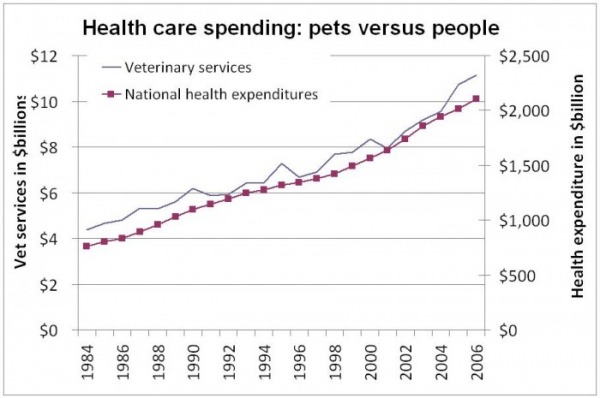
    If you compare those premiums to the average prices of some veterinary bills, the monthly payments may not seem that high. The website Petplan reports that the average bill for a pet that swallows something they shouldn’t have is about $1,755, and joint-related bills average at $3,480. Further, according to the American Pet Products Association reports sales in vet care in 2017 were $17.07 billion and over $18.26 billion in 2018.

    The Bottom Line…you don’t ever want to have to choose to no let Fido have comfort due to your lack of fund$.

    Our sweet Buddy awaits his Exam.

    Imagine your dog getting into your fresh baked oatmeal-raisin cookies, it’s 10:00 at night and he begins to vomit profusely. This on top of your car being in the shop last week and your “Emergency $avings” is no more. What do you do? This is YOUR FUR BABY, your FAMILY MEMBER! Well, there is an option…nooo, not selling your first born to the highest bidder.

    Interviewing our local Humane Shelter Director, Charmaine Rastatter told me recently that there are so many dogs dropped off at the shelter for no other reason than because the pet needed medical attention that the owners were unable to financially provide for. As an ethical breeder, I state in my Health Contract that if someone is ever not able to care for the dog, I have the first “right of refusal”. Meaning, I want the ability to care for the puppies-turned-dogs that were bred and reared in my home. All pets deserve a chance! **

    For a lot of people, they have to use CareNet, the high-interest “Credit Card” which is touted as “insurance” when you are unable to pay for medical bills (for you or your furry friend). On their site I read: For use”On qualifying purchases of $200 or more made with your CareCredit credit card account at enrolled provider locations. Interest will be charged to your account (at the rate of 26.99% for new accounts) from the purchase date if the promotional purchase is not paid in full within the promotional period. Wow! This should help us all make the decision on how we will help our Dog during the rough patches in life.

    **Watch for the blog post “What happens when you HAVE to say good-bye to your best friend, our dog?” Walking through grief. Coming later this summer.

  • It’s Just So Confusing!!

    We adore these pets of ours. They are innocent and trusting…and, oftentimes so are we. Its a challenge…Why can’t we all agree on ONE THING to keep our pets healthy and safe? Believe me! I know!!! Between the Vet Office, the local Pet Store, our Breeders (me) and all the other “voices” (on line, my brothers mother-in-laws second neice, you know…). It’s just like everything…there’s a bazillion ways to look at anything. Many people just bury their head in the sand…and then there’s us. The bottom line is that we CARE for these sweet furry family members and we want the VERY BEST for them. So, here we are…knowing that ignorance is NOT bliss! Knowledge is your Power! I want to help you…together we will find the answers YOU are looking for.

    The bottom line is that there is a HUGE market for YOUR dollars. Follow the $ trail and keep doing your own research for your beloved family members. Fortune Magazine wrote an article a few years back (2016) on “Pet’s are Basically People” ( http://fortune.com/2016/09/07/pets-are-basically-people/ ) that we are humanizing our pets.

    Translation = there is a market for YOUR dollar$.

    “Sixty-eight percent of U.S. households, or about 85 million families” (2018)

    https://www.iii.org/fact-statistic/facts-statistics-pet-statistics

    So what is a person, especially those of us on a tight budget or fixed income to do when we want…need our pets? We need to know where to turn for answers! I agree. Believe me. I have worked inside a Vetrinarian Hospital, I have almost always owned a dog, cat, and other animals. I am right with you. I hope to help bring light to the reasons behind the mysterious challenging opinions vs. facts in the dog and pet industry and empower you to continue being that amazing pet owner I am sure you already are! Join me in exploring topics such as: Food Industry, Grooming, Vaccines, Exercise, Parasite, Flea & Tick Regimes, Insurance, Spaying & Nutering, Therapy Animals, Testing for Health, Loss of a Furry Companion…and so much more!

  • To Groom…or NOT to Groom, that is the Question.

    I tend to observe a furry companion as an extension of self, home and family. Whether it is my pet or another person, of course, we do judge by appearances. Before bringing yet ANOTHER mammal home, I need to ask myself if I have the 1.) time, 2.) patience, 3.) financial means 4.) desire to give to this animal what it needs.

    Grooming is part of the package we all need to look at with an open mind to the DOG’S needs.

    Personally, I was drawn to the natural look of the Cavalier. Having spaniels in the past (Springers), I loved the rugged “Grinchy” feet, long chest and side hair, and, of course, that loooooong, feather-y tail. When I flew out to North Carolina to pick up my blenheim boy, Willy, I was amazed at how little he shed. A quick search on the internet shows these loveys are “high maintenance” and they “shed quite a lot”. Honestly, this has NOT been my experience. Of course, the mild Northwest (U.S.) temps are part of this, but I think a LITTLE grooming goes a LONG way with the Cavvys.

    Me and Willy in his natural state…no groom and not brushed (this day).

    Living with an amazing and wonderful yellow Labrador Retriever who was everything our family could ever imagine…except for the hair, hair, hair…everywhere! And he HATED being brushed!! I could sweep/vacuum a PILE every day. Ugh (where was the “Rumba” when I needed one so desperately?

    Fast forward…now I have 5-6 dogs and puppies frequently in my Kennel Home and I am amazed at how LITTLE I have to keep up on my floors. I attribute it to the FUR on the lab vs. the HAIR on my Spaniels. Both have a double, or under coat. So, what’s the difference and how do I maintain a beautiful home AND dog?

    FUR is almost always short and thicker than hair, (follicles per sq. inch). Fur also goes through a faster growth cycle, and so sheds more heavily. HAIR is generally smoother, longer and finer than fur (which attributes to the “silkiness”). Either can either be straight, wavy, or curly. Both tend to have an undercoat that needs to be combed out regularly to stay on top of the fur bunnies in the corners of our dining room.

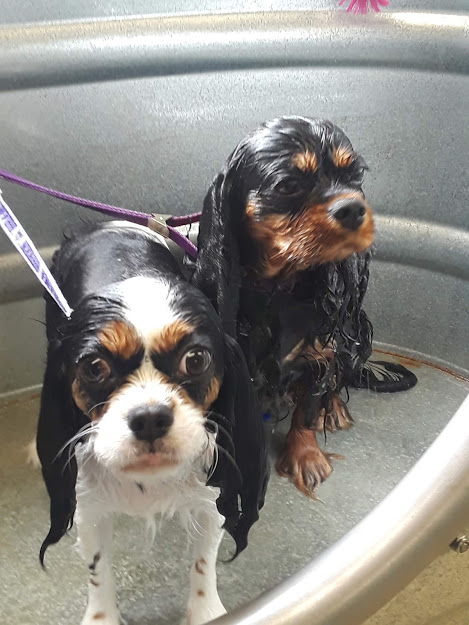
    Mercy and Elysha don’t mind their monthly baths.
    We treat it like a day at the “Spa”.

    People inquiring about puppies or the breed ask me how much maintenance is involved with the upkeep of my lovely dogs. I always ask them “when is the last time YOU think I brushed or washed this dog”. They usually say “today”. Nope, most likely it was last WEEK and bathed last MONTH.

    After our monthly grooming “Spa Day”, too tired to keep their eyes open.

    The Cavalier King Charles Spaniel Breed Standard, aka: what is acceptable to Judges around the world may be different than what YOU prefer. The Standard is NO thinning or trimming, except for under the paw pads, not the hair around the feet though. Take an inventory: Do you live where burrs and mud can easily get under the coat of the dog and between the paw pads? Is my boy not quite “lifting” high enough, therefore I need to keep his belly trimmed tight? Are my pooches eyebrows and whiskers out of control and need a little trimming? YOU are the Judge of your own sweet furry companion. I’m here to help YOU.

    Most of us like the “look” of the beautiful Cavalier, but not the weekly maintenance, so this is how I keep my furry friends looking so sharp. I pick A DAY that works for me each week and go over them thoroughly: 1.) a good comb (known as a pin brush or de-matting “rake”) to help with the daily/weekly snarls. Deal with them asap so you don’t have to CUT. This is a good time to utilize that flea comb (more on Fleas: ) 2.) Use an electric trimmer to get in and around the paw pads when needed (think spring and summer). During the MUDDY winter months I trim around the front and tops of feet, especially for the ones who despise me wiping too much (see above picture). I also SHAVE the underside of the ears and trim up the long feathers that you don’t see when the ears are down (see above). I will address ear care and treatment on another blog. This is also a good time to remember those toenails (and dew claws) I’ll address this one later as well. 3.) Brush the undercoat with a shedding blade or undercoat rake. You may need to LIFT the top layers in order to properly brush out the undercoat. I have several brushes I use for this and will be adding to comments soon. 4.) No more than once a month give a nice warm bath (any more, that nice sheen of the natural oils may be harmed). Peanut butter on the side of the tub so your dog can lick helps those who might not enjoy their bath time. 5.) When fully dry (some like to use a hair dryer on lowest setting, be sure to wipe ears and be sure all moisture is gone) use a slicker (boar hair) brush.

    Should I shave my dog during the summer?

    Clipping or shaving a Cavalier’s coat (some refer to this as the “Puppy Cut” might seem like the best approach to keeping your dog cool.

    Image provided by http://www.Rover.com
    • The longer topcoat hairs actually protect your dog’s skin from the heat and sun. It’s like an insulator.
    • Your pet’s topcoat provides a water shield, keeping the skin and undercoat dry as well as provides protection against mosquitoes and other insects.
    • Your Cavalier’s coat may grow back thicker and curlier, rather than returning to the long silky coat most admired in this breed (this is a bit controversial and could be different based on YOUR dog). The “Puppy Cut” (apx. a Size 7 Blade all over) is most common throughout the world to keep the hair manageable.

    In short, clipping your Cavalier’s coat short may actually increase the risk of sunburn and overheating – the opposite of what you intend! I keep fans going and have the cooling mats around the house. Most of our home and yard have several “cooler” areas (we don’t need a/c except for a few days in the summer). I’ve even used an old fashioned “swamp cooler” (fan blowing over ice) for the dogs when I felt it was needed. We have a kiddie pool in the backyard filled with fresh water and sometimes they will even wade in it. No shave needed!

    Is a Professional Groomer Necessary for this Breed?

    If what I explained above seems like a LOT for you and your schedule, then you need to find a Groomer who you can work with. I start by sharing this picture I found on the “Cavalier King Charles Spaniel Stomping Grounds”. It’s one of a few drawings that I use as a guide – and I give my preferences as well:

    I’ve taken my dogs to a Groomer ONCE. She was wonderful with all the dogs and did a fantastic job with them. I was getting ready to do some traveling with my five (above) and did not want to take the time, in addition to packing, etc. I liked it so much, I think I will make this my spring and fall “treat”. We were the only one’s in the Groomers area, they weren’t kept in kennels, they had a play area and truly seemed to have a good time. Like breeders, finding a good Groomer takes time and interviewing to find the right one for you.

    Find a picture of a dog that you like and bring it in. It will help you to communicate to your Groomer – truly they want to do what YOU want them to.

    What has been your biggest challenge about grooming your Cavalier or dog?

  • Fleas, ticks and other Parasites…it’s getting itchy in here!

    Our humble abode with our youngest and “Queen Mercy”.

    We have spent a lot of time “Summer-izing” our yard this past week. Many hours of weed pulling, weed whacking, John-Deering, sprinkling powders and natural sprays and, in general, preparing ourselves for “that time of year” when the little pests want to jump on us, our 4-legged friends and reap their havoc. This Post is to help you “weed” through the truth of these varmints!

    Everywhere we go, there are ads for the collars, sprays and gels to fight these parasites. Parasites are one of the most common health problems that our animals will face. The most common parasites are fleas and ticks while others include intestinal parasites like roundworms, tapeworms, hookworms, whipworms and heartworms. I hope to help you navigate through all the commercialization and streamline the mystery.

    How Can We Prevent Parasites?

    Preventing (“ounce of prevention…”) fleas and ticks is easier than ridding yourself of an infestation, so taking precautions is the very best method. There are a number of ways to prevent fleas and ticks, and it’s best to approach protection and prevention from multiple angles.

    Firstly, the very best way to keep fleas and ticks away from your pet is by keeping your home, yard and pet clean and clear from being the kind of place these varmints will want to land in.

    Last fall the FDA put out a warning against the topical and oral medications due to many reports of seizures and even deaths. The high probability toward adverse reactions make these a terrible option for our beloved furry companions. A short Google search will show you more than you want to know about what has become all too normal. Here’s one link to adverse reactions that have been linked to the top sources of flea medications (I’ve been following the petitions and challenges for several years: https://www.isbravectosafe.com/bravectotruefacts.htm

    There are better, less expensive ways !

    So, do you want to know what have I done to ward against these pesty varmits? I plant rosemary, and lemon balm around the perimeter of our home. After a good mowing and weed-wacking (like yesterday), I will sprinkle Diatomacious Earth all over the lawn, flower beds and anywhere my dogs spend time. More about DE here: https://richsoil.com/diatomaceous-earth.jsp I also purchased the yard and lawn care concentrate from Wondercide (uses a high concentrate of Essential Oils) and sprayed the perimeter of the yard: https://www.wondercide.com/outdoor-pest-control/outdoor-pest-control

    We pulled up ALL carpets and removed fabric-types of furniture this past winter, so keeping those little buggers off the floors and main sitting rooms should be easy-peasy. I washed all the pet beds (twice a month) and have sprinkled cedar chips in and under their beds. Just like outside, I diffuse EOs (Essential Oils) such as lemon, eucalyptus, and rosemary in several places in my home. Not only do I NOT use toxic chemicals in my home, I use e.o’s to clean counters and floors and around door frames helping keep fleas as well as mosquitoes at bay. Bathing the dogs (apx. once a month) using any one of the EOs above as well as Neem Oil helps externally. I also think of keeping the INTERNAL parasites away as well is simple:

    Put Your Pet in a High Alkaline State

    It’s easy to check the ph of your pet using the Alkaline Strips. 7.0 and higher does not draw parasites, in fact, some people believe it might deter them. How do I do that? Read on…

    First of all, I have done a LOT of research about the pet food industry and I am convinced that for the health and well being of my dogs, I now grind and feed my pets raw meat fruit and vegetables. In addition, I add apple cider vinegar to their drinking water. Yes, it’s just that easy. For the internal parasites, I grind a few natural sources (pumpkin seeds and black walnut to name a few) to add to their food (added bonus, it helps with expressing the anal glands as well). See this site for more ideas: https://www.top10homeremedies.com/pets/home-remedies-intestinal-parasites-worms-dogs.html When I take my pets to the Veterinarian, I am sure to bring a stool sample to have them test and make sure I am being thorough. So far, we are doing great!

    Dealing With A Current Infestation

    If you already have experienced a flea problem, it’s important to act fast to get rid of it. Fleas multiply at a rapid rate and the problem gets worse by the day. Fleas do seem to like the sweetness of puppies, and you should be extremely cautious when applying ANY medicines or even essential oils to puppies under 6 months (use a flea comb daily to remove nits/eggs and larva).

    Look around your home and yard with a keen eye for places that parasites might be lurking. Things like wandering cats and dogs, keeping garbage locked up tight to keep out rodents, etc. and by keeping your yard mowed and free of tall weeds or grasses will deter any little bugger!

    Late Spring and early summer are good times to remember to protect your home and yard!

    Regularly Check Your Pets For Fleas And Ticks

    I comb and groom my pets a few times a week (call it therapy for me), but Friday Nights have been my “Weekly Routine” to check each one thoroughly with a flea comb (in addition to cleaning ears, teeth, nails, etc.) Regularly check for signs of fleas, ticks and parasites (yes, you HAVE to look at the poo!). If you live in an area that is tick-prone, and if your pet spends time outdoors, you’ll need to check for ticks regularly, as they are carriers of diseases for both animals and humans. And, of course, when we are expecting puppies and having those little ones in our home, we are extra careful to comb and rid any and all pests, combing daily.

    Bella enjoying her pre-labor “spa time” on my bed.

    This map shows if your area is prone to lymes disease:   https://www.petsandparasites.org/parasite-prevalence-maps#2019/all/lyme-disease/dog/united-states/ Even though I live in an area that is claimed to not have any reports of lymes from ticks, I do know that Deer ticks are alive and well in our area. I personally know several dear friends who have suffered the horrid disease. Remembering that a little effort goes a long way, I will do what it takes to protect all my loved ones! Should you remove a tick from your beloved furry family member, its easy to put in a zip-lock baggie and bring into your Veterinarian to test for lyme.

    Remember, it’s easier to prevent the challenges in our lives as well as the lives of our pets rather than peddling backward. If you choose to medicate, please do your research before giving to your pet, no matter what way you choose to protect. Choosing NOT to protect is also an option…remember, it’s your choice. Have you used another method that you believe really works? Please let all of us know!